PERU
The Inca Heartland:
Sacred Valley and Beyond
Highlights

Tracing the Sacred Peaks
In Andean cosmology, the mountains are living spirits: apu, meaning lord or powerful one in Quechua, watch over the communities in the valleys below, governing crops, livestock, and fortune. Ausangate and Salkantay, the two most powerful apu in the Cusco region, are considered spiritual brothers. Ausangate draws thousands of pilgrims each year to the Quyllur Rit'i festival; they trek for six hours through the night to a glacier at nearly five thousand metres, to make offerings to the mountain before dawn. The relationship between the Quechua communities and these peaks has survived the Spanish conquest, Catholic conversion, and five centuries of change.

Apurimac River Adventure
The Apurimac has roared through the Andes for millenia, earning its name as ‘the speaker of the gods.’ These waters feed the Amazon. To raft here is to surrender, as the rapids hurl you past waterfalls, ancient ruins, and white-sand beaches. Gentler stretches offer you a moment to breathe, to take in the otherworldly rock formations and the condors circling above the canyon walls. This is an ecocystem that changes with every bend in the river.

The Salt Pans of Maras
On the hillside of Maras, over four thousand shallow, terraced pools glimmer in the sun. A single underground spring feeds them salt-rich water, which evaporates slowly in the Andean heat, leaving behind pink crystals. Local families own and maintain these pools: regulating the flow of water, monitoring salt formation, and harvesting the salt by hand. This cycle of work has been passed down through the generations, binding the community to the rhythms of the valley.

The Lake Where the World Began
The Incas considered the Titacaca the centre of the cosmos. Standing at the shore, watching the horizon disappear in the infinite blues of the sky and water, it is not difficult to imagine the god Viracocha rising from the lake to create the sun and moon. The Incas built palaces, temples, and shrines across the islands. For centuries, the Titacaca has also been home to the Uros people, who live on golden, floating platforms out of Totora reeds. At the world’s highest navigable lake, the lines between the present, history, and mythology wash away.

Weaving with the Women of Chinchero
The women of Chinchero are keepers of the Andes’ textile traditions. They spin and weave wool using techniques passed down across generations. Dye yarn in shades of the earth, will plants like ch’illca and qolls, or dried conchineal bugs. Create intricate designs like the Luraypu, a geometric form surrounded by natural symbols. In a region known as the mythical birthplace of the rainbow, the art of weaving ties the community together and to the landscape.

The Andean Explorer
One of the highest railway routes in the world departs Cusco and climbs across the Andean Altiplano. The journey feels like a pilgrimage, passing Inca ruins, stopping at caves housing prehistoric rock art, and culminating at La Raya, where the horizon gives way to snow peaks and golden plains. The journey takes one or two nights, stopping at Lake Titacaca before continuing south to Arequipa. The ride itself is a ritual, as the train becomes a gallery where passengers can take in the landscape while enjoying nightly music in a piano bar and dining on food grown at altitude. Here, time is measured by the shadows dancing across the Altiplano. This is “slow travel” in its truest sense.

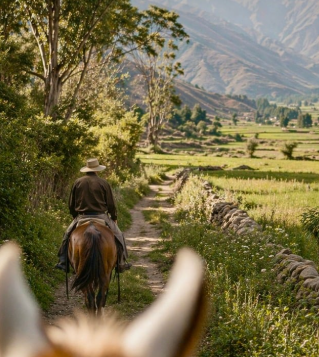
Out of this landscape, one of the greatest civilisations of the ancient world was born. The Incas saw these mountains as living beings: apu, lords in Quechua, who watch over the valleys below. In less than a century, the Incas built an empire around that relationship with the land; an empire that stretched the full length of the Andes. The terraces they cut into the valley walls still hold crops. The roads that once connected 4,000 kilometres of Andes still thread through the landscape. The Incas’ languages, cosmology, and textile traditions survived the Spanish conquest and continue in the communities that line the valley today.
The mountains of central Honshu run through the heart of the island like a spine. The Hida, Kiso, and Akaishi ranges rise to peaks over three thousand meters high; snow dusts their summits into late spring and their steep, jagged slopes give way to narrow valleys carved by fast-flowing rivers. The communities that settled on this terrain were isolated from the rest of Japan for centuries, cut off by the heavy snowfall and rugged passes. Life here was shaped as much by what the alps provided as by what they denied.